
CLN8 Research in Oulu:
In Search of a Therapeutic Approach for “Northern Epilepsy”
A research project funded by the NCL Foundation uses a precise mouse model to investigate CLN8 disease mechanisms and test a potential therapy.
The NCL Foundation is funding a new research project at the University of Oulu in Finland focusing on the rare disease CLN8. The project will run from March 2026 to August 2027 and is led by Professor Dr. Reetta Hinttala. We are particularly pleased that this funding supports a PhD student who has a personal connection to the NCL Foundation.
CLN8 mutation leads to BMP deficiency in lysosomes
CLN8 disease belongs to the group of neuronal ceroid lipofuscinoses (NCL). The variant known as “Northern Epilepsy” typically manifests during school age and is especially common in Finland. Compared to other NCL forms such as CLN3, the most common type, it progresses somewhat more slowly, initially presenting with epileptic seizures followed by motor and cognitive decline.
The disease is caused by mutations in the CLN8 gene. This gene encodes a protein that plays a key role in the production of the molecule S,S-LPG at the cell’s endoplasmic reticulum (ER). S,S-LPG is subsequently required in the lysosome for the synthesis of the lipid molecule BMP, which is essential for proper lysosomal function. If the CLN8 protein is absent or defective, BMP levels in the lysosome decrease, impairing the lysosome’s ability to carry out its recycling functions. This ultimately leads to the neuronal cell death characteristic of NCL diseases. Since reduced BMP levels have also been observed in other NCL forms such as CLN3, CLN5, and CLN11, CLN8 research is relevant for multiple NCL disorders.
Testing a new therapeutic approach in a CLN8 mouse model
This is where a central approach of the project comes in: by providing the precursor molecule in a targeted manner, cells may be able to produce BMP again without relying on the defective CLN8 protein. Previous studies by researchers at the University of Cambridge have already shown in cell cultures, zebrafish, and a CLN8 mouse model that administering S,S-LPG successfully normalizes BMP levels. However, this effect has so far mainly been demonstrated in the liver in mice.
The research group in Oulu now aims to investigate this approach using a more genetically precise CLN8 mouse model and specifically in brain cells. They have established a new knock-in mouse model that accurately replicates the most common disease-causing human CLN8 variant responsible for “Northern Epilepsy.” This model reproduces key features and symptoms of the disease. Using this model, the researchers will examine in collaboration with Cambridge researchers whether the precursor-based approach can also normalize BMP levels
Another focus of the research is on microglia, the immune cells of the brain. While these cells can have protective functions, they may also promote inflammation and contribute to neuronal death. The team will investigate how disrupted BMP metabolism in CLN8 affects the pro-inflammatory behavior of these cells.
“Our research could be relevant not only for people affected by CLN8. Since reduced BMP levels occur in several NCL forms, future findings - and particularly a potential therapeutic approach - can ultimately benefit a broader group of patients,” says Professor Reetta Hinttala, head of the Pediatric Neurology Group at the University of Oulu.
A special connection to the NCL Foundation
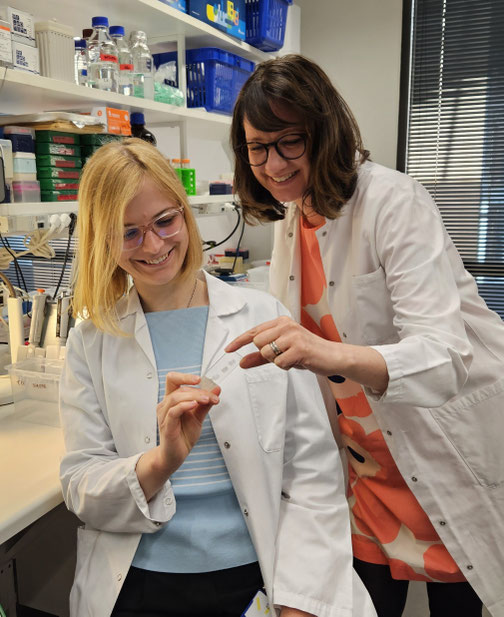
The funded project is part of the doctoral research of Jessica Müller-Niva. The PhD student from Germany participated in the NCL Foundation’s school project as a student. Today, she conducts research in a laboratory in Oulu on the very diseases she first encountered through the foundation’s work. At the same time, the NCL Foundation is now supporting her scientific career through its research funding.
Project at a Glance
Principal Investigator: Prof. Reetta Hinttala
Institution: Research Unit of Clinical Medicine, Faculty of Medicine,
University of Oulu, Finland
Project Duration: 01.03.2026 - 31.08.2027
Project Goal: Using a new mouse model, the aim is to investigate the role of BMP loss in CLN8 (Northern Epilepsy). In doing so, both fundamental disease mechanisms in the brain will be explored and a potential therapeutic approach to restoring BMP levels will be tested.
14/04/2026
NCL-Stiftung
Holstenwall 10 · 20355 Hamburg
Tel. +49 (40) 69 666 74-0
Fax +49 (40) 69 666 74-69

SPENDENKONTO
bei der Hamburger Sparkasse
IBAN: DE50 2005 0550 1059 2230 30
BIC: HASPDEHHXXX
Bleiben Sie in Kontakt mit uns:


Zur besseren Lesbarkeit wird auf dieser Website teilweise auf genderneutrale Doppelungen verzichtet.
Alle Formulierungen gelten gleichermaßen für alle Geschlechter.
Wir sind Mitglied:


